
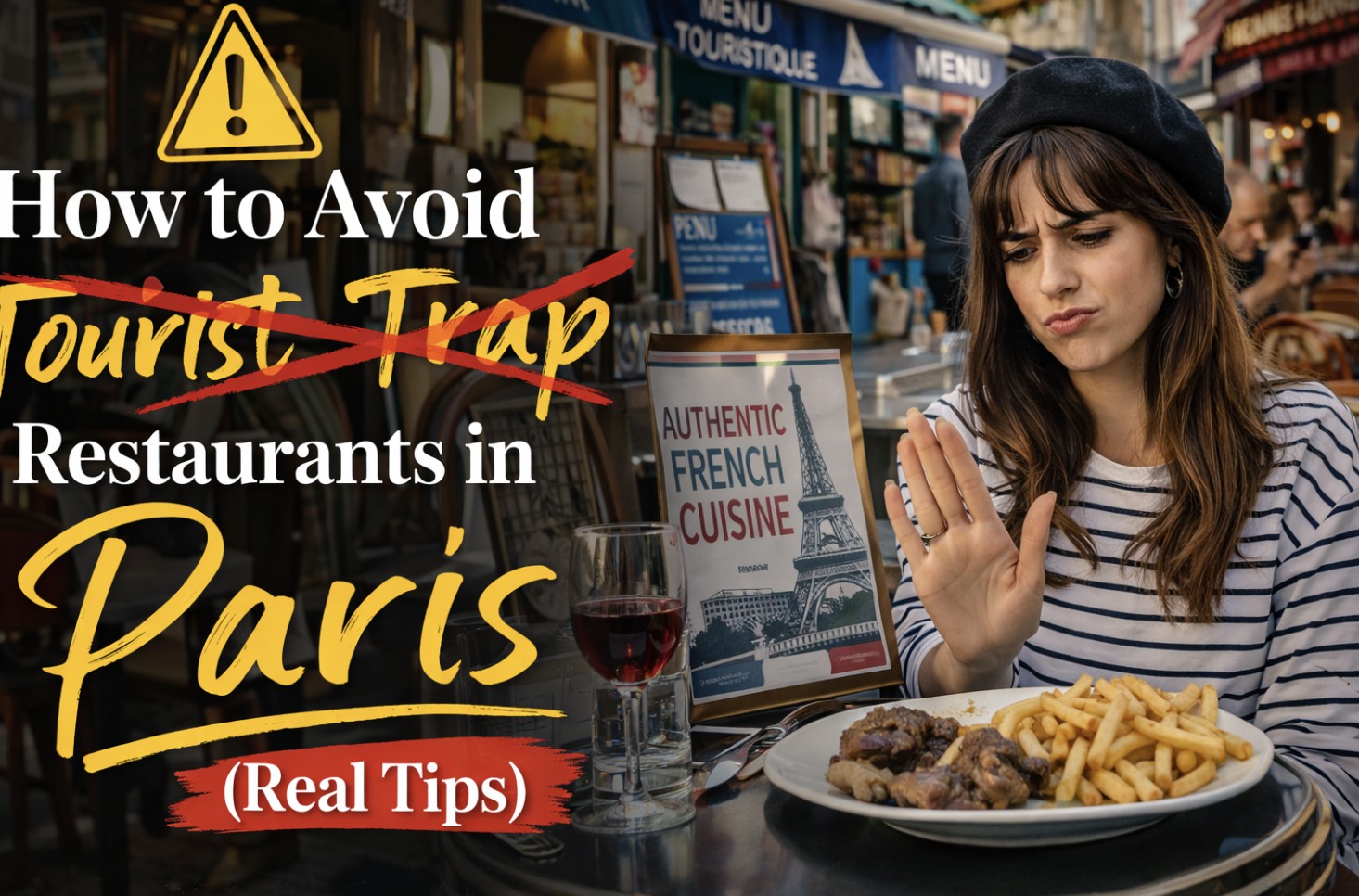
Paris attracts millions of visitors every year, and restaurants in high-traffic areas don’t need to rely on repeat customers. That changes everything. Instead of focusing on quality, many places focus on volume, speed, and visibility.
This is why you can eat incredibly well in Paris—or very poorly—just 50 meters apart. The difference is not luck. It’s knowing what to look for.
The Biggest Red Flag: Location Over Quality
The easiest way to spot a tourist trap is the location.
Be extremely careful around:
- Eiffel Tower surroundings
- Champs-Élysées
- Notre-Dame area
- Montmartre (especially near Sacré-Cœur)
Restaurants here survive on foot traffic, not reputation. You’re paying for the view, not the food.
The rule is simple: walk 5–10 minutes away from major landmarks. Quality increases fast, prices often drop.
Menus That Scream “Tourist Trap”
The menu tells you everything.
Avoid places with:
- Menus translated in 5+ languages outside
- Photos of dishes displayed at the entrance
- Huge menus with everything (pizza, burgers, pasta, sushi, crêpes…)
- Fixed “tourist menus” at suspiciously low prices
Good restaurants in Paris usually have a short menu, focused on a few dishes, often changing regularly.
If everything is available all the time, it’s usually frozen or industrial.
Staff Behavior: A Clear Signal
In Paris, good restaurants don’t chase customers.
If someone is outside trying to convince you to sit down, it’s almost always a bad sign. Locals don’t need to be convinced—they already know where to go.
A strong restaurant is busy, confident, and does not need aggressive sales tactics.
Look Inside Before You Sit
Always take 10 seconds to look inside.
Ask yourself:
- Are there locals or only tourists?
- Is the place full or empty during peak hours?
- Does the food look fresh and simple or over-decorated and generic?
A restaurant full of Parisians at lunch or dinner time is one of the best signals you can get.
Timing Matters More Than You Think
Tourist traps are open all day. Good restaurants follow French eating hours.
Typical schedule:
- Lunch: 12:00 – 14:30
- Dinner: 19:00 – 22:30
If a place serves full meals at 16:30 or 18:00, be cautious. It’s often designed for tourists, not locals.
Check the Menu Logic (This Is a Pro Trick)
A high-quality restaurant usually has:
- A short menu
- Seasonal dishes
- A clear identity (bistro, seafood, wine bar, etc.)
A tourist trap tries to please everyone.
If you see:
- 40+ dishes
- Multiple cuisines mixed together
- No seasonal logic
You’re not in the right place.
Price vs Value: Don’t Be Fooled
Cheap menus in tourist areas are rarely a good deal.
A “starter + main + dessert” for a very low price often means:
- Pre-made food
- Frozen ingredients
- Low-quality sourcing
In Paris, a fair price for a quality lunch menu exists—but it’s usually found outside the main tourist zones.
Use Google Maps the Smart Way
Reviews can help—but only if you read them correctly.
Do not trust only the rating. Look for:
- Recent reviews
- Comments from locals or frequent travelers
- Mentions of specific dishes
Avoid places with:
- Thousands of generic reviews
- Comments focused only on location or view
- Repeated mentions of “tourist menu” or “overpriced”
Safe Strategy for First-Time Visitors
If you want to avoid mistakes completely, follow this simple plan:
- Eat in Saint-Germain, Le Marais, or the 11th arrondissement
- Walk away from landmarks before choosing
- Choose busy places with short menus
- Avoid anything that looks too convenient
This alone removes most bad options.
Final Rule: If It Looks Easy, It’s Probably a Trap
Tourist trap restaurants are designed to be easy: easy to find, easy to understand, easy to choose.
Good restaurants in Paris require a little more attention—but the reward is huge.
If you slow down, observe, and apply these simple filters, you will naturally avoid bad places and experience the real food scene of Paris.